

Medline is one of the largest manufacturers and distributors of medical supplies in the world, with thousands of products. If you’ve ever used crutches, a wheelchair, medical gloves, gauze bandages, or any other type of hospital-quality medical supplies, there’s a good chance you’ve used products by Medline.
According to Tanja Zaric, Senior Content Market Manager on Medline’s marketing operations team, the company has nearly two thousand sales reps across numerous divisions and sales segments. When their sales reps make a presentation, they have a huge, highly detailed, and technical set of information that they have to convey, and each presentation must be tailored for the specifi c needs of each client.
For many years, they had product managers putting together beautiful, polished presentation slides, but there wasn’t a central library where all of these slides could be readily accessed. As a result, there was a huge and ever-growing amount of content on the company’s intranet, which meant reps often had to look in several places in order to find the most up-to-date and approved versions of slides.
This made it a bit inconvenient to create a consistent story across all of their sales divisions, and consistency is vitally important to an esteemed medical supply company like Medline. When they communicate information to the public, whether they’re sharing financial numbers or product information, they are always careful to ensure that everything has been fully vetted by their regulatory team for compliance issues.
Additionally, the Medline brand has evolved over the years, so content has been regularly updated and refreshed. For all of these reasons, leaders knew they needed to somehow bring together all of their presentation content in a way that ensured structure, order, and consistency at all times, while also making up-to-date slides conveniently available to sales reps in every circumstance.
It was clear to leaders that accomplishing this was going to take more than a single project. It was going to require the right platform, the right training, and a whole new presentation culture—a culture in which presentations were treated with the same meticulous care, consistency, and oversight as any other major form of marketing communication.
When the company went through a rebranding, it seemed like the best time to get started. They decided to use our Shufflrr Presentation Management platform because it could quickly and efficiently roll out the change in branding to everyone in the field. As they trained team members on the new brand, they also taught them a new Presentation Management culture.
According to Tanja, they structured their slide library like the table of contents in a book, where each of their more than twenty sales divisions, representing products and capabilities that are marketed to different sales segments, had its own chapter. Each chapter was populated with relevant slides for the sales reps in those divisions. They further subdivided the chapters into sales segments, and then imposed a hierarchy that was logical to sales reps so they would never again have to spend a lot of time looking for relevant slides.
This was particularly important in the early days of the change, as reps learned to use the slide library and got acquainted with search functionality. Medline wanted reps to quickly embrace the new tool as they navigated this whole new culture of Presentation Management, so they made the transition as logical and easy to adopt as possible.
That little bit of extra work up front has been well worth it, because Medline now has better and more focused communication, a central resource of branded, consistent content for sales reps to easily create impactful and visually appealing presentations in minutes. While sales reps focus on selling, content strategists design, create, and update the slide decks, envisioning the company’s overarching story and considering carefully how each slide fits into it.
The sales reps can easily find the specific presentation slides that they need, trusting that they have the most up-to-date information at all times. It doesn’t feel like marketing is forcing content onto them. Rather, they are simply being helped so they can focus their efforts on what they do best.
A Critical Component For Every Campaign
Presentation Management is more than a process, tactic, or approach—it’s actually a culture that impacts your entire organization for the better, a strategy that treats presentations as a critical component of your sales, marketing, and advertising campaigns.
Every medium of communication has its own culture, if you think about it, with its own production processes, lingo, and experiences. And there are two sides to that culture: the strategic creative side, and the actual production process.Consider the culture of print media. First, you’re identifying your audience, gathering information, writing copy, designing layout, meeting deadlines, and selling ad space— that’s the strategic creative process. Then you have the actual printing and distribution of the newspaper, which involves a printing press, processes, and deadlines, as well as the tactile reality such as the sound of the machines, the smell of ink, and trucks arriving at the crack of dawn to pick up the newspapers. All of these elements together, from both the creative side and the production side, combine to create a print media culture.
And this isn’t limited to communications. The same goes for architecture, which has both the strategic creative process that results in a blueprint, and the production process, in which construction crews and carpenters actually build the thing. The same goes for the culture of cooking, which involves the strategy of creating recipes and bringing together ingredients, and then the process for making the food. In all of these examples, the various processes and experiences for both the strategic creative side and the actual production come together to create a culture.
The same is true of presentations. There’s a specific culture around Presentation Management that involves both a strategic creative side and the publishing and delivery of the presentation. This culture has its own processes, lingo, experiences, and approach. We’re not creating this culture—we’re merely identifying it. And it’s a culture that is evolving naturally as companies develop and embrace new ways to manage their presentation communications.
In many organizations, there’s usually one person who is really good at creating presentations, and everyone goes to that individual for help and support when they need to create a slide deck. However, in a culture of Presentation Management, everyone gains the ability to present effectively because they are empowered through Structured Storytelling. They can do it themselves.
That one person in your organization who has been the go-to for presentations becomes a guru who helps everyone unleash the real potential of the slide library, but they no longer have to act as a crutch. Every team member becomes an expert at presentations, able to communicate the company’s story clearly and respond to client questions and concerns at a moment’s notice.
The Language of Presentation Management Culture
The culture of Presentation Management, like any culture, has its own language and way of communicating. This language is what we call Structured Storytelling. With Structured Storytelling, every presentation tells a story, and every slide is a scene in that story. Additionally, there’s always an emotional component combined with the logical component of any message. Emotion comes first, and then logic is used to reinforce the emotion.
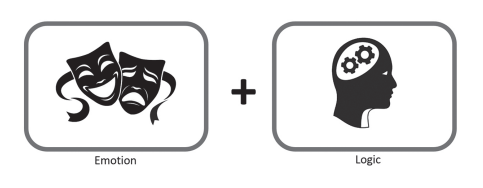
The structure typically looks like this: first you present a moving story, then you share the facts, then you close the deal. Some media companies do this very well. We first noticed this when we worked with NBC to present the Olympics to advertisers back in the late 1990s. NBC’s presentation led with a video of Muhammad Ali at the Atlanta Summer Olympics in 1996, his whole body shaking from Parkinson’s disease as he lit the Olympic torch. It was a powerful story that moved the audience. Reps then followed the story with the “numbers.”
Lead with emotion, reinforce with logic. That’s the language of Presentation Management. Why? Because emotion creates motion. Emotion is visceral. It grabs the audience like a hook and gets them to act, then logic and information give them justification for taking that action.
“Wow, the Olympics can be really moving and powerful,”they say. “I would love for our brand to be associated with stories like this. And, oh, look at the viewership. It’s also a good investment to advertise on the Olympics, according to these ratings.”
That’s the progression of thought when using Structured Storytelling. You are trying to create an emotional connection with your audience, and then following it up with facts and figures to give a logical purpose for those emotions. Of course, this is just one component of Structured Storytelling, but it’s an important one.
55 At the same time, the language of Presentation Management follows the conversation, it doesn’t force the conversation, because once you’ve created emotional momentum in your audience, you want to go with them on the journey.
Imagine you’re on a Zoom call with a few clients. One of them brings up a topic related to one of your products, and, as it turns out, you already have some graphics in a folder on that topic. So, you open the folder, pull out the graphics, and share them on your screen with the clients right then and there. The graphics reinforce the conversation, and they help both you and your client make the point. It’s a fluid, spontaneous conversation, not a forced, rigid slideshow—active participation instead of passive reception.
THE LANGUAGE OF PRESENTATION MANAGEMENT
- Every presentation is a story; every slide is a scene.
- Lead with emotion; reinforce with logic.
- Let the presentation follow the conversation, not force it.
If you’re a CEO, then you are probably the best presenter in your company, the one person who can most clearly articulate your brand value. Embracing the culture of Presentation Management will empower everyone in your company to speak as intelligently and articulately as you about your products and services. At the same time, every piece of marketing content in your entire organization is now formatted as a slide, ready to present, so every team member, from the most outgoing and charismatic to the shyest introvert, has the tools and information they need to present clearly to any colleague, client, customer, partner, or investor at any moment.
Nobody has to build or rebuild slides every time they present, because once a slide has been created, it is readily available to be used over and over again. And because you can search through slides visually, you’re never looking for the proverbial needle in a haystack. You can find the file you want much faster, which makes reusing slides and customizing presentations more efficient. This, in turn, ensures that every level of your organization from the CEO on down can articulate the same on-brand message with the same language and data.
This culture of Presentation Management has enabled every member of Medline’s enormous team—all two thousand sales reps throughout the world—to sell a vast and highly technical range of products to a wide array of healthcare professionals with many different needs. And every single one of those reps is telling a consistent story about the brand, with the same lingo and the most current information.
Now, instead of slides being created by sales reps for a single presentation then disappearing forever into some folder on the network, every slide—every scene in every presentation—has an evolving life cycle that allows them to continue telling the company’s story. And to become more effective and impactful over time.
Let’s take a look at that life cycle next.