

“The Olympics is about more than gold medals,” Kerri Strug said. “It’s about human spirit, the heart, and the drive that a lot of athletes have and human beings have in general.”5
She should know. Her own story lives on in the memories of all who witnessed it (either in person or on television) in Atlanta in 1996. She was the last to vault for the United States gymnastics team. On her first attempt, she underrotated, landed badly, and injured her ankle. Despite the injury, she received a score of 9.162, but she needed to land a second vault in order to clinch the gold.
Honestly, nobody would have blamed her if she’d stopped there. She had a pronounced limp and was clearly in pain.However, Kerri decided to make a second attempt at the vault. It is a moment that has been played and replayed over and over again.
Kerri limps to the end of the runway and goes for her second vault, running full steam ahead. Somersaulting off the ramp, she lands perfectly on both feet, salutes the judges briefly, then collapses to her knees in agony.
The commentator, John Tesh, can be heard on the video saying, “Kerri Strug is hurt! She is hurt badly!”
For her second vault, she was awarded a 9.712 by the judges, which guaranteed the American team a gold medal.
Video of that final vault has been played countless times in the years since, and it always has an impact on the audience. Kerri’s Olympic story, full of both determination and pathos, is far from unique. If you watch the Olympics, you’ve seen many of these kinds of stories, stories of athletes overcoming hardship, facing triumph and defeat, victory and disappointment, joy and pain. These kinds of stories give Olympic events even more gravitas, and the networks that air the Olympics know it.
It’s the reason why the network gives you touching stories about athletes and the adversities they’ve overcome before 87 you watch them compete. As we recounted earlier, legendary boxer Muhammad Ali appeared at the same 1996Summer Olympics as Kerri Strug. Ravaged by Parkinson’s disease, he mounted the steps and raised his trembling hand to light the Olympic torch.
A young salesperson at NBC first had the idea of using Muhammad Ali’s emotional moment, and other moments like it, to sell the Olympics to advertisers. We were in the room when they made their presentation, and we watched the power of those videos firsthand. That salesperson had learned an important lesson: powerful stories tie your entire presentation together in a way that keeps your audience invested from beginning to end.
Now, we should point out, the emotional response to Kerri Strug’s final vault varies, and it has changed somewhat over the years. At the time, it was mostly seen as a powerful example of willpower and sheer determination, but more recently, some find the video a troubling example of a young athlete being pushed too far by an overbearing coach.That’s why it’s important to understand both the emotional impact you want to make, as well as the impact you’re likely to make on your target audience.
Choose and design your content wisely to achieve your desired effect. Know your audience, and be ready to pivot or adjust based on their reactions and feedback. That’s what good storytellers always do. The presentation 88 follows the conversation and reacts to the audience— Structured Storytelling makes this easy.
The Martin Scorsese Of Presentations
Structured Storytelling is about creating presentations that don’t just throw information at people; they tell a compelling story. Your organized library makes it easier to tell more effective stories that move your audience, where every slide is a scene in that story, and every scene makes an emotional impact.
A celebrated director like Martin Scorsese doesn’t include a scene in a movie like Goodfellas, The Departed, or The Wolf of Wall Street unless he knows what kind of emotion he wants to evoke in his audience. He considers very carefully how people are supposed to feel about each character, about each plot development, and he meticulously plans the layout of each scene. The scenes are strung together in such a way that they create an emotional resonance, which builds toward some overall feeling he wants to leave the audience with at the very end.
89 First, there’s a happy scene where the main characters are having a good time. They tell jokes, laugh, and enjoy life.Then suddenly, there’s a bloody and violent scene where one of those characters is brutally murdered. The juxtaposition of a happy mood with a violent act jars the audience.It grabs their attention and stirs their emotions. After that, we get a scene that shows the surviving characters racked with sadness and anger. Finally, we build toward a scene where the victim’s friends seek revenge.
Each of these scenes creates emotion, builds suspense, and makes the story exciting for viewers, but strung together, they build an overarching emotional journey for the audience. By the climactic scene, the audience is rooting for the hero to get revenge in a bloodthirsty fashion and either celebrating his success or lamenting his failure.
We’re not suggesting that your presentations need to create the same mood as a Scorsese film (although that might be interesting), but we are encouraging you to view presentations as yet another way to tell impactful stories to an audience.
Muhammad Ali lighting the Olympic torch wasn’t just about kicking off the 1996 Olympic Games. It was a story of a once-great superstar athlete dealing with a debilitating disease who rose above the challenge to participate in a historic event. The will of the champion was still there in that frail body. NBC’s Olympic salespeople included it in their sales presentations to advertisers because it was a powerful human story of triumph and tragedy, courage, and willpower, and it honored a great American hero. But it also provided an emotional context for understanding the power of running ads on Olympic broadcasts.
Evaluate each slide you use as a scene in a movie that is taking your audience on an emotional journey. What is your audience supposed to feel during the scene? How are they supposed to react emotionally to the content? Even if it’s just a pie chart, consider what emotion it’s supposed to evoke. How is that scene supposed to lead out of the slide before it and into the slide after?
When you make every slide a scene in a movie, then your product, service, or message becomes the hero of the story. Muhammad Ali wasn’t the real hero of that video; the Olympics were. And the story of that hero goes something like this: “The Olympics creates powerful, moving, humanizing moments about drive, determination, and glory, overcoming adversity to succeed, as well as the agony of defeat. They show humanity at its most visceral. That’s why people tune in. We don’t watch just to see people run faster, jump farther, or throw a javelin. We watch because of those human stories of triumph and defeat. The power of those powerful human stories reflects very well on any brand, individual, organization, or nation associated with them.”
Most people feel anxiety about giving presentations because, in most linear presentations, the presenter is the focus. The presenter is the “hero” of the presentation. But when the product, service, or message becomes the hero of an emotional story, the focus is shifted off the presenter. Because they’re telling a story and taking the audience through a series of scenes, not just trying to present dry information, they can relax a bit and let the story itself do some of the heavy lifting. The pressure is taken off the presenter and put back onto the product, service, or message, and once the pressure is off, it’s a lot easier to present and talk with confidence.
The Muhammad Ali video, the Kerri Strug video, and other powerful moments from Olympic history created strong emotions in those sales presentations. Can you imagine how much harder it would have been for the presenter to create an equally strong reaction just from sharing ad numbers, market studies, and information about pricing?
Storytelling is one of the most effective tools in your toolbox for making better presentations that move, entertain, and inspire your audience. And your audience will be grateful for it. Nobody wants to sit and listen to a full presentation of data or a bland sales pitch, but every human being on earth resonates with stories.
If you want to stand in front of a room full of people and convince them to do something, a compelling story is always going to be the most effective way to do it. This is why lawyers tell stories in their opening and closing arguments during a trial. It’s why American presidents include personal stories about real people in their State of the Union addresses. It’s why companies use case studies.
Shift the focus from yourself to the real hero of the story: your product, service, or message. Take the audience through a story about that hero scene by scene, and build a narrative. Start with emotion, because emotion resonates with the audience, then follow with information. When you do this, the information gets tied to the emotion. Suddenly, all of those dry stats about viewing audience, cost, ROI, and so on get connected to moving moments like Muhammad Ali lighting the Olympic torch.
Transforming A Slide Into A Scene
So, how do you begin turning your slides into scenes that provoke some specific emotion in your audience? It may not sound easy to turn pricing information into an emotional scene, so here’s a tip from one of our presentation designers:
“Begin with a thought-provoking statement, a headline, and connect it to a dramatic image or video. Remember, a picture paints a thousand words, but pictures also create a lot more emotion. Watching a video or looking at a picture is always more engaging than forcing someone to read text in a presentation format.”
For each slide, ask yourself the following questions:
- Who is the hero of this slide and what is the hero trying to convey to the audience?
- How should the audience feel by the end of the slide?
- What knowledge should they have gained?
- How will they have moved along the story line of my
presentation?
You can boil this down to five things that we can use to evaluate each slide: the hero, the message, the feeling, the information, and the next action. Once you’ve identified each of 94 these things for a slide, find a visual to communicate them.
Text alone is almost never powerful enough, so we recommend always looking for some visual to make your scene more effective.
In fact, it might be helpful to construct each individual slide as a meme, combining an image or video with provocative text designed to provoke a feeling, draw a contrast, or visualize a conflict. Think, for example, of the famous meme where a couple is holding hands, walking down a sidewalk, while the boyfriend turns and looked over his shoulder at another woman. That single meme communicates an entire story unto itself and creates an immediate emotional response in viewers.
That meme is called the “distracted boyfriend,” and all kinds of quotes and phrases have been attached to the image to make a variety of points or social statements. For example, there’s the one where the boyfriend is identified as “millennials,” his girlfriend as “financial stability,” and the other woman as “avocado toast.” Depending on what generation you come from, you will have a variety of strong responses to that version of the meme.
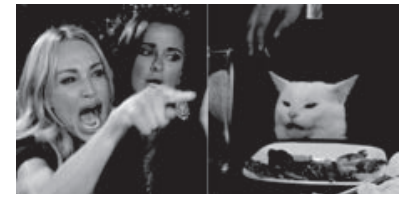
Generally, memes are meant to encourage debate or provoke a response, but they can be used in many different ways as long as you’re creative. You’ve probably seen the meme where the blonde woman is yelling and pointing at a distressed (or possibly confused) white cat, as the cat sits behind a dinner plate of what appears to be steamed vegetables. It’s actually a 95 juxtaposition of two unrelated images, the cat from Tumblr (his name is “Smudge”) and the woman from an episode of The Real Housewives of Beverly Hills (her name is Taylor Armstrong). That single meme has been used thousands of times because, as silly as it is, it instantly creates a sense of conflict in a humorous way.
FIVE QUESTIONS FOR EVERY SLIDE
- Who is the hero of this slide/scene?
- What is the hero trying to convey to the audience?
- How should the audience feel by the end of the slide?
- What knowledge should they have gained?
- How will they have moved along the story line of your presentation?
What Story Are You Telling?
Memes are helpful for creating structure in a slide, but remember, a slide isn’t just provoking a feeling, it’s helping to tell a story. If you treat your presentation as a story, and each slide as a scene in that story, you are guaranteed to make a greater impact on your audience.
Instead of a disjointed series of slides, you will create motion as you move from slide to slide, taking your audience along on an emotional journey. Think of it this way: emotion creates motion. That’s what storytelling does.
It’s really no different than what a great writer does. Each scene has a specific role to play in moving characters along the plotline toward a climax and resolution. Just apply that same thinking to your presentations, and it will all start to come together in a powerful way.
How does emotion create motion, practically speaking? First, you create an emotional scene, then you follow it up with data, and you conclude by telling the audience to do something. That’s the motion you’re creating: make your audience feel something through an emotional scene, reinforce that emotion by providing them with information or data, then ask them to do something as a result.
Let’s suppose you’re making a presentation for an engineering company that designs and manufactures brakes for automobiles. You start your presentation with an emotional scene that shows how brakes keep people from crashing. Maybe you tell a harrowing true-life story about a family that lost control on an icy road and almost slid into a ravine, but your company’s brakes worked despite the ice and saved them at the last possible second. Then you provide some statistics on vehicle safety with your brakes.Then you encourage the audience to purchase your brakes.That’s emotion creating motion.
The Muhammad Ali video that the NBC salespeople used was a powerful story all by itself. When that scene was placed within the context of the rest of the NBC sales presentation, it communicated the power of Olympic moments, the impact they make on a global audience, and the way they speak to the strength and nobility of great athletes. And that, of course, flows right into the overarching message: that advertisers would be tapping into a powerful message of human achievement by teaming up with the Olympics.
Based on the principles we’ve just described, an account executive with only two years of sales experience can take a powerful presentation like that and instantly become a great presenter, because the story alone does most of the hard work. Of course, there are many different ways that the Muhammad Ali video can be used within the presentation.It might work at the beginning as a way to set the emotional stage, or it might work better near the end, to drive home the impact of the message.
And even if the slide isn’t included in the presentation initially, the presenter can decide on the fly to pull it out of the slide library.
“Oops, my audience seems to be losing interest in my presentation. I’d better pull that Muhammad Ali video out of the library so I can regain their full attention.”
That’s what we mean when we say your presentations become a conversation instead of just a linear slideshow.
You’re able to react to your audience to keep them invested in the story. If you need a sudden emotional component to bring them back, you can reach into your library, grab that video like your secret weapon, and play it.
Let’s suppose your presentation is trying to convince an audience to invest in a school. There’s a lot of dry information that needs to be shared, many different numbers to throw at the audience. Halfway through the presentation, you realize you’re getting glazed-over looks from people, so you pull out a video of the championship football game from a few years back. It’s a clip from when a local hero, the team’s running back, won the game, a victory that led to him getting the Heisman Trophy. The video clip ends with his teammates carrying him off the field on their shoulders, while his parents cry tears of joy in the stands.
By sharing that video, you tell the heartwarming tale of a heroic moment and tie it to the larger story of the school’s impact on students and the community. Suddenly, your audience feels invested in those numbers and the glazedover looks go away.
“This story is what our school is all about. These triumphant moments in the lives of students and their families—that is what you’re supporting when you invest in us.”
James attended the University of Houston, and a highlight of his years at the school was watching Andre Ware win the Heisman Trophy in 1989. The night before the fateful game at Rice Stadium, James stayed up all night with friends printing T-shirts that said, “Where is the Heisman?” When it was announced that Andre had won, the cheerleaders all donned the shirts and flipped across the field.
Actually, the event is also notable for creating a bit of legal trouble. The first shirt design included Andre Ware’s name, and a team of lawyers sent James a warning that this might make the player ineligible for award consideration. James and his friends scrambled to make a second design, which relied upon the homonym between “where” and “Ware” rather than using the player’s name directly. And the rest is history6.
To this day, James can reference the Heisman experience when speaking to UH alumni across the nation to create an instantaneous emotional connection that evokes all kinds of happy memories. And, as we said, emotion creates motion.
Make every slide a scene, use compelling visuals, and tell a story that will resonate with your audience. That’s how you create better presentations for everyone. With that understanding, you’re ready to begin implementing Structured Storytelling throughout your organization.
5 Lily Kuo, “Gymnast Strug Motivates Others with Story of Gold,” Reuters, 2012, https://www.reuters.com/article/us-oly-gymn-wstrug-idUSBRE85R0AQ20120628 .
6 “New York Event Inspires Confidence and Cougar Pride | Highlight Houston.” University of Houston. http://development.uh.edu/highlight-houston/new-york-event-inspires-confidence-and-cougar-pride/