

In a meeting room at ABC National Television Sales in 2006 – before the iPhone, before cheap thumb drives, before easy cloud storage – we learned a hard lesson about PowerPoint presentations and the pace of technological change. That lesson started us on our journey to develop the concept of enterprise presentation management.
We are a brother-sister team, and we have been consulting with enterprise clients, providing presentation technology and creative services for over 20 years.
James worked at a boutique agency called Micro Interactive. One of the agency’s early customers was CBS Networks, which bought an advertising sales presentation solution to help sell its sponsorships for the 1998 Nagano Olympics. Broadcasters were early adopters of presentation technology – because there is no better way to sell TV sponsorships than with images and video.
In the 1990s, video running on a laptop was pretty cutting edge. From broadcasters, the trend toward presentations that incorporated graphics, animation, video and sound spread to other enterprises.
Micro Interactive built a pretty nice business designing and developing custom sales solutions – and Micro Interactive was soon purchased by the web development company iXL in the midst of the late-1990s dotcom boom. James joined iXL as head of sales for multimedia services, and later spun out his division into a new company, Iguana Interactive.AlexAnndra left her advertising agency career to join Iguana Interactive.(This is how we wound up working together. Our mother is so happy.) In the first 18 months, Iguana Interactive developed and designed presentation solutions for clients such as the National Basketball Association, the National Football League, Comedy Central, AmericanExpress, Kelly Services, Bravo, De Beers and Mercedes-Benz. Not a bad roster for a start-up. Unfortunately, when the dot-com bubble burst in 2001, so did Iguana Interactive’s. The investors decided to close shop and walk away.
After 9/11, in a depressed New York City, we metaphorically (and maybe even physically) pulled Iguana out of the dumpster. James was the final creditor to Iguana Interactive, so he traded his employment contract for the Iguana software. With two borrowed desks, a phone and a ping pong table that doubled as a conference table, we started Ontra Presentations. We cold-called old clients, who were pissed that Iguana closed shop on them, and tried to find some new clients. We finally landed ABC National Television Sales.
Yet by then, something interesting was happening to business presentations. The software to make presentations moved from clunky and expensive CDs running locally on laptops and desktops, to softwareas-a-service tapped through networks and the cloud. Video that was once expensive to produce and required highly skilled directors and editors turned into a commodity — anyone could make a video on a smartphone.The entire spectrum of presentation creation got democratized.
And this is what led to the moment at ABC. An exasperated sales rep walked into our meeting and threw a CD on the table. “My grandmother made a nicer presentation for our family reunion than our sales presentation!” OUCH. It became obvious to us that the problem to solve concerning presentations would no longer be how to create them. It would be how to manage all the presentations that would be created by all the individuals at every level of an organization.
We knew we had to build a new solution to keep up with ever more accessible technology and clients’ expectations.
And yet, we also realized that while technology had changed, the reason our clients called us in the first place remained the same. For almost 30 years, clients across all industries have listed their presentation problems as:
- There is no compliance or consistency of message across the team.
- No one knows what all of the employees are presenting and to whom.
- It takes too long to prepare presentations for meetings.
In short, enterprises want more control over the presentation content while making managers, salespeople, marketers and anyone else who relies on presentations more productive.
And so, we developed the discipline of presentation management and built technology to support it – and have continued to learn from clients who adopt presentation management so we can constantly improve and update our approach. Clearly, the era of one-and-done decks is over.
Instead, smart organizations apply presentation management to create and manage decks like enterprise assets.
Presentations as Enterprise Assets – The Strategic Approach
It is time to usher in long-term thinking about presentation objectives. A company’s best presentations combine the best ideas from top leadership with professional writing, sleek graphics and precise branding.Presentations are a form of branding. That can benefit everyone in the company over the long term, rather than just a few people in one meeting.
Presentation management positively affects everyone in the company, from the C-suite to the field manager. In fact, companies that adopt robust enterprise content management and presentation management strategies stand to realize a 400 percent ROI within five years of adoption, according to research by information management company M-Files. In order to transition from a “one-and-done” presentation mentality to an enterprise strategy, organizations must think differently about their strategic communications and presentations.
Simply put, presentations are strategic communications, and they deserve the same discipline and strategic approach as other elements in the communications mix. Think about how your company approaches PR, social, digital, advertising – with set objectives, planning, production, execution and measurement. Presentations should be no different.
Presentation Management Increases Productivity
Make your content productive The core benefit of presentation management is the ability to create great content once, and then make it available to anyone in the organization to use over and over again. Typically, that content is a PowerPoint deck, but it could also be a video, PDF brochure, white paper or infographic.The format doesn’t matter. What matters is the ability to take any piece of content and unleash it across the organization.
Consider the cost of paying all those highly skilled marketers, writers, designers, producers, analysts and other subject matter experts to plan, produce, execute, measure and then revise presentation content. It adds up to an estimated $1 billion per year. Organizations are making a monumental investment in their content. Unfortunately, some 70 percent of content created by marketing goes unused, according to Translations GlobalLink. And over 90 percent is never reused. Companies are squandering $900 million of marketing assets annually. Yikes!
Put that content to work. Put it in a cloud location, where presenters can easily find what they need and drop it into decks. That will get you a better return on your marketing investment. An effective presentation management strategy will direct the best content to the employees who need it, when they need it. Presentation management will make it easy for the user to find files and slides, and then repurpose them for their meeting. They don’t have to start from scratch re-creating a slide that already exists somewhere, if only they could find it. It also means presenters can access content when they are actually in the meeting, face to face with the client. So when the client throws a curve-ball question that the presenter hadn’t anticipated, she can go to the presentation library on the fly and present content that answers the client’s question.She doesn’t have to “wing it” or tell the client that she’ll send that info over later.
Presentation management means the right content is directed to the right person at the right time. So naturally, the content gets used more – and more effectively. The more content gets used, the more value it has.Presentation management gives a higher return on your company’s investment in content.
Make your team in the field more productive
If the content is more productive, the team will be more productive as well.
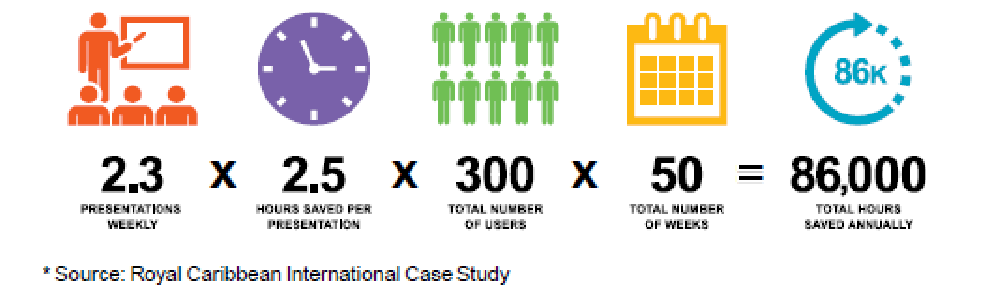
Client feedback has told us that presentation management can save two to five hours in preparation for a meeting. Royal Caribbean Cruises Lines estimated that their presentation management solution saved 300 business managers 2.5 hours per presentation. Multiply that over 50 weeks, and you’ve just unleashed an additional 86,000 hours of productive time. That’s time that can be spent building relationships with clients and partners, solving clients’ unique problems, innovating for the company, or working on initiatives that actually build the business, as opposed to the tedious administrative task of creating a new deck that already exists somewhere.
Every sales person saved 5 hours per week
Presentation management takes workers out of their cubicles and puts them back into the world. But what happens when they are already face to face with a client, partner or other colleague? It lets them approach presentations in an entirely new way.
The presentation follows the conversation. The best salespeople listen, then respond and react to what their clients are conveying. A one-anddone slideshow forces the speaker into a rigid, linear story with little room for spontaneity or creativity. But successful business is conducted through relationships, and relationships are built through interactive dialogue – a volley where both sides share and build on each other’s last comment.
Today, when a real discussion starts in a meeting, the slideshow is typically left behind. One slide just languishes, ignored on the monitor.
Presentation management allows on-demand access to a comprehensive library where users can actually search and present a slide or file. When the client redirects the conversation, i.e., the presentation, the presenter can present the content accordingly. And this content is already compliant and up-to-date.
So the presenter can follow through with the right materials and advance the relationship. No longer does he need to schedule another follow-up meeting, or chase the client down for the next couple of months to get that second (or third, fourth or even fifth) meeting. The presenter can address all of the issues on the spot.
Presentation management reduces the number of meetings and time needed to close a deal, allowing the rep to chase more deals in the same time frame. Furthermore, when you can answer a client’s question on the spot, you look smarter, and are smarter. You build credibility for yourself and for the company. Trust builds long-term profitable relationships.
Elevate the value of the content creators
When the content generates a higher return on investment, and your team is more productive because of how they are using that content, then that trickles right up the ladder to the content creators themselves. From the writers to the designers to the strategists and producers, many people from different disciplines contribute to a piece of marketing collateral.Presentation management increases the value of their work and how it’s perceived across the organization.
As a high-level example, let’s consider materials prepared for a huge conference, where the CEO is the keynote speaker. The budget and profile is typically pretty big for such an event, easily running into the six figures. The marketing department creates a presentation, using professional copywriters, graphic designers and animators. Other department leaders also contribute content. Then, perhaps, a video is produced – again with professional writers, directors, videographers, makeup artists, etc. The costs keep rising.
With presentation management, elements of that presentation can be reused and repurposed, quickly and easily.
We’re not implying that everyone in the company can give the CEO’s keynote presentation. But with a presentation management strategy in place, it will be much easier and more common for the rest of the company to reuse and repurpose assets from that presentation for their own meetings.
The same results hold true on a more mundane level, since we know that most presentations don’t have a $100,000 budget and are not given by the CEO. A presentation created for a sales call is actually used multiple times across the entire sales team. The content creators’ product affects 300 people in the company over the course of a year, versus two people in the company over the course of one meeting. With presentation management, the effort of content creators is elevated from a one-anddone tactical exercise to a strategic initiative benefiting the entire organization. In so doing, the content creators get more exposure and contribute more value throughout the company.
On top of that, presentation management directs the content to the presenters in the field. The content creators field fewer last-minute, panicked requests, like:
- “Hey, I have a meeting in one hour, where is the new pricing?”
- “I can’t find the slide!”
- “Do you mind, just, putting these few slides together for me?”
Marketing puts out these fires every day. Every time a last-minute request comes in, everything else drops. The day is derailed. Worse, the day is derailed by a request for something that already exists! Fewer fires to put out means the marketing team can put their resources to strategic initiatives that build the brand and push the business forward.
Presentation Management Ensures Compliance
Compliance can mean different things to different organizations. In finance and pharma, it means that specific language and statements are disclosed in accordance with federal regulations. You must tell your customers “this” but you are not allowed to tell them “that.” What employees can and cannot say is regulated. And “who” can and cannot present certain material is also regulated. In finance, you must be a certified broker-dealer to sell investments. In pharma, you might need to be a medical doctor to educate other doctors about how to administer a particular drug. In marketing, compliance means that you are staying true to the brand, which refers to the colors used, the logo treatment, the fonts and typography, even certain messages and taglines.
Compliance can also mean the products and pricing are up to date. Every industry, every business, every division within that business has rules that they follow, with which they must comply. When we refer to presentation compliance, we are making sure that all of the content presented follows those rules, whatever they may be for your company.
In the discipline of presentation management, compliance is controlled through a number of elements working in concert.
Permissioned access: Who gets access to which content is important for two reasons. First, it ensures that qualified people have access to their information. You wouldn’t want a research assistant presenting company financials. That’s a lousy way to prove the company is a sound investment opportunity. Second, you don’t want the research assistant wasting his time wading through financial content, when what he really needs to do his job are the results of some focus group. Permissions not only protect the company from risk, they direct the employees to the information they need to do their job well.
Forced content: Forced content benefits both legal and marketing. In highly regulated industries like finance and pharmaceuticals, companies are required to include legal disclosure statements with the information they present. If they don’t, they will have a regulatory watchdog knocking on their doors and run the risk of expensive and even debilitating lawsuits and fines. From a marketing perspective, you want to be sure that your people are telling the “complete” story about the product and/or the company. So, you force certain slides, content, etc. into their presentations.
Organization-wide updates: It’s so easy for users to pick up that last version of the deck they used for their last meeting because it’s saved on their desktop. They know exactly where it is. It’s faster and easier for them. But in doing so, they risk presenting outdated, wrong and noncompliant content. The risk of misinformation could result in a regulatory fine, an angry client and lost revenue. When slides and files are updated by a content administrator or expert, those updates are pushed out to all users, ensuring that everyone stays current — and therefore compliant.
Reporting: Knowing who is presenting what to whom, when, and in what context provides documented evidence that the company is following regulatory guidelines, maintaining industry compliance, and presenting the complete story. Are your sales reps presenting the latest pricing? Did they include the right disclosure statements? You’ll know through reporting.
The road to hell is paved with good intentions. Compliance protocols and processes are fantastic from a high-level enterprise point of view. Yay, control! But the folks on the front lines, working directly with partners and customers need to be flexible, creative, responsive and above all, they cannot wait until “compliance” approves their deck. Boo, bureaucracy! Presentation management balances compliance with productivity. At the end of the day, your workers — sales reps in particular — are judged by the quality and quantity of their work, of what they do. Sales reps are measured by how much they sell, not whether they used the right shade of blue in their PowerPoint template or remembered to include the right legalese. Presentation management understands that dynamic so your enterprise can promote its brand while your team can get their job done.
Chapter 2 – Takeaways
- Presentation management is a strategic approach to presentations, treating them as enterprise assets that can be used over and over again throughout the organization.
- Presentations are strategic communications that deserve the same level of attention and discipline as branding elements.
- Presentation management provides a greater ROI on your content because reuse of the content multiplies.
- Presentation management empowers your team to create better presentations in less time. It makes them more productive.
- Interactive features let the presentation follow the conversation, unlocking presenters and their audience from rigid, linear slide decks.
- Presentation compliance refers to legal messaging, marketing messaging and branding elements. It makes sure that everyone’s presentations are following the “rules” for that business.